
Japan Rail Pass Guide: Is It Still Worth It?

The Japan Rail Pass (JR Pass) has been a staple of trips to Japan for decades. It gives unlimited travel on most Japan Railways (JR) Group trains for a fixed number of consecutive days. After a significant price increase in October 2023, however, it is no longer an automatic purchase. This guide explains what the pass covers, how to use it, and how to decide whether it will save you money.
What the pass is
The nationwide JR Pass is sold in 7, 14 and 21-day versions, each in Ordinary and Green (first class) classes. The days are consecutive from the start date you choose. It covers:
- most JR Shinkansen lines, with an important exception for the fastest services (see below);
- JR limited express, express, rapid and local trains;
- some JR buses and the JR ferry to Miyajima;
- certain JR lines inside cities, such as the Yamanote Line in Tokyo.
It does not cover private railways, subways (other than JR lines), most city buses, or non-JR long-distance buses.
Nozomi and Mizuho trains
For many years the pass could not be used on Nozomi and Mizuho, the fastest trains on the Tokaido, Sanyo and Kyushu Shinkansen. Since October 2023, pass holders can ride them by buying a supplementary ticket for the journey. Hikari, Sakura and Kodama trains remain fully covered, so many travellers simply use those and accept a slightly longer ride.
Who can buy it
The nationwide JR Pass is intended for visitors entering Japan with "Temporary Visitor" status. Rules for some other groups have changed over time, so check the eligibility conditions on the official Japan Rail Pass website before buying. You will need to show your passport when you collect or activate the pass.
How to buy and activate
You can buy the pass from the official online sales site, from authorised resellers, or at a limited number of major stations in Japan. The process usually looks like this:
- Buy online or from a reseller and receive a reservation or exchange order.
- In Japan, go to a JR ticket office or a compatible ticket machine with your passport.
- Choose your start date. The pass runs for consecutive calendar days from that date.
- Reserve seats for free on covered trains at ticket machines, ticket offices or, for passes bought on the official site, online.
Tip: you do not have to start the pass on arrival. If you spend your first days in Tokyo, start it on the day of your first long journey.
Is it worth it? A simple method
The fastest way to decide is to list every long-distance train journey you plan to take, find the normal single fare for each, and compare the total with the pass price. A few rules of thumb:
- One return trip between two cities (for example Tokyo to Osaka and back) is usually cheaper with individual tickets.
- A loop with several long legs inside the pass period – for example Tokyo, Kyoto, Hiroshima, then back to Tokyo with a trip to the north – is where the pass is most likely to pay off.
- Regional passes often beat the nationwide pass if you stay in one area. JR West, JR East, JR Kyushu and JR Hokkaido all sell passes for visitors that cover their own region, often for fewer days and less money.
Tokyo2Us shows fares for each leg as either a recent cached price or a labelled estimate. Use them as a guide, then confirm the exact fare with JR before deciding.
Seat reservations and luggage
Reserved seats are free with the pass on covered trains. On the Tokaido, Sanyo and Kyushu Shinkansen, suitcases above a certain size (total dimensions over 160 cm) must be booked into a seat with an oversized-baggage area. Reserve this when you book your seat. Smaller bags fit on the overhead racks.
Green Car or Ordinary?
Green Cars have wider seats, more legroom and quieter cabins. They are pleasant on long rides, but Ordinary cars on the Shinkansen are already comfortable. Green passes make most sense if you plan many hours on trains, or if you travel during busy periods when Green Cars are often less crowded.
Alternatives to the pass
- Individual Shinkansen tickets bought at stations or online.
- Regional rail passes for the area you are visiting.
- Highway buses for budget legs, especially overnight.
- Domestic flights for long hops such as Tokyo to Sapporo or Fukuoka, where flying is much faster.
Compare all of these for each leg of your trip with the Japan country guide, which links popular journeys like Kyoto to Osaka and Osaka to Hiroshima.
Worked example: a two-week first trip
Imagine a classic first itinerary: land in Tokyo, spend several days there, then take the train to Kyoto, make a day trip to Nara, continue to Hiroshima and Miyajima, and return to Tokyo to fly home. Write down each long-distance leg: Tokyo to Kyoto, Kyoto to Hiroshima, Hiroshima back to Tokyo, plus the local Nara and Miyajima trips. Look up the current single fare for each one, add them up, and compare the total with a 7-day pass. Remember that the pass clock starts on activation, so the days in Tokyo at the start should usually not be included. If the legs cost about the same as the pass, the convenience may still be worth it. If they cost noticeably less, buy separate tickets or a regional pass.
Regional passes worth comparing
JR companies sell many regional passes that cover a smaller area for fewer days. Examples include passes for the Kansai area, the Kansai–Hiroshima area, the JR East region and Hokkaido. These are often better value than the nationwide pass for trips that stay in one part of the country. The rules on which trains are covered differ between passes, so check each pass's official page for what it includes before you buy.
Quick checklist before you buy
- List every long-distance leg and its current single fare.
- Check which trains the pass covers and whether supplements apply.
- Count how many consecutive days you will actually use it.
- Compare with regional passes and with plain tickets.
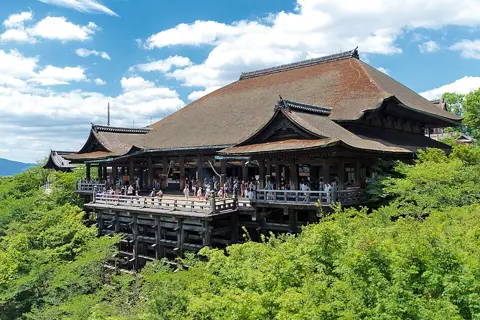
Photo credits
Photo: Jordy Meow, CC BY-SA 3.0
FAQ
- Can I use the Japan Rail Pass on Nozomi trains?
- Yes, since October 2023, by buying a supplementary ticket for each Nozomi or Mizuho journey. Hikari and Kodama trains are covered without a supplement.
- Is the JR Pass worth it for Tokyo and Kyoto only?
- Usually not. A single return between Tokyo and Kyoto or Osaka is normally cheaper with individual tickets. Add up your planned fares and compare them with the current pass price.
- When should I activate my JR Pass?
- On the day of your first long-distance train journey. The pass runs for consecutive days from the start date, so starting it while you are staying in one city wastes days.
- Does the JR Pass cover the Tokyo Metro?
- No. It covers JR lines in cities, such as the Yamanote Line, but not Tokyo Metro or Toei subway lines.
Partner links may earn us a commission at no extra cost to you. Learn more
Related guides
 RailSeoul to Busan: KTX, SRT, Express Bus or FlightCompare every way to travel from Seoul to Busan: KTX and SRT high-speed trains, express buses, flights and driving, with practica…
 RailRome to Florence by Train: High-Speed vs RegionalHow to get from Rome to Florence: high-speed Frecciarossa and Italo trains, slower regional trains, buses and driving, with pract…
 RailParis to Amsterdam by Train, Bus or CarHow to travel from Paris to Amsterdam: direct high-speed trains, connections via Brussels, coaches and driving, with tips for che…